

2026.06.30

Enhancing Network Resilience with AEWIN Gen4 LAN Bypass

Share:

Introduction

Traditional LAN bypass focuses on keeping traffic flowing when a system goes down, but modern deployments require greater flexibility to balance availability and security. AEWIN Gen4 LAN bypass builds on the Gen3 foundation by introducing enhanced traffic control mechanisms to enable network behavior to better align with real-world operational demands.

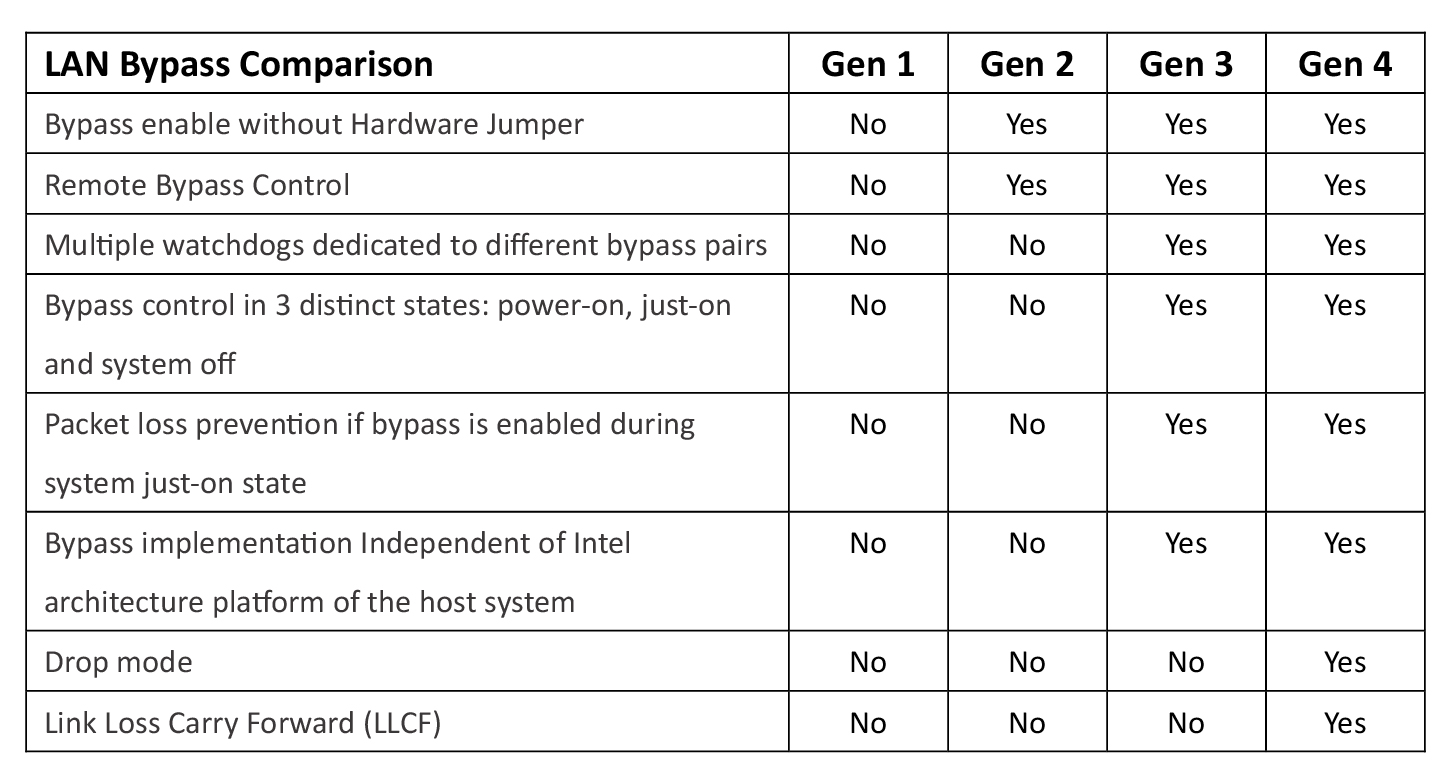
AEWIN LAN Bypass Generational Comparison
Gen4 LAN Bypass-02

AEWIN Gen3 LAN bypass significantly improved reliability with features such as watchdog control, platform independence, and stable fail-open behavior for continuous connectivity during system failures. It establishes a solid and reliable bypass foundation. Building on this, Gen4 introduces behavior-level control to allow systems to respond differently depending on deployment requirements.

AEWIN Gen4 LAN bypass takes this a step further by adding Drop mode and Link-Loss mode. Instead of relying primarily on fail-open (bypass) behavior, the system can now either block traffic or actively signal the network to trigger failover. This enables a more flexible approach where network behavior can be adapted based on whether availability or security is the primary concern.

Further details of the four bypass modes are listed below.

-        Normal Mode

In Normal Mode, all traffic is directed to the CPU for full inspection and policy enforcement. This is the standard operating state where all security, monitoring, and networking functions are fully active.

-        Bypass Mode

When system failure occurs, Bypass Mode directly forwards traffic between ports without passing through the CPU. This ensures uninterrupted connectivity and represents the classic fail-open behavior which is adopted widely in firewalls and network monitoring tools to prevent downtime.

-        Drop Mode

Drop Mode blocks all traffic from passing through the system. Although the link may still appear active, no data is transmitted. This mode is designed for security-critical scenarios where preventing uninspected traffic is more important than maintaining connectivity which is consistent with zero trust principles.

-        Link-Loss Mode (LLCF)

Link-Loss Mode makes the connection appear disconnected to upstream devices when a failure is detected. To utilize Link-Loss Mode, the LLCF (Link Loss Carry Forward) feature must be enabled. This allows the system to physically simulate a cable disconnection, ensuring upstream devices can instantly detect the failure and trigger an HA failover.

Summary

AEWIN Gen4 LAN bypass enhances Gen3 designs by introducing Drop Mode and Link-Loss Mode to enable more flexible and intelligent handling of network traffic during failures. Instead of relying solely on fail-open behavior, AEWIN Gen4 bypass allows systems to either block traffic for security or trigger failover for high availability. It is critical for modern network infrastructures that demand both deterministic security control and resilient service continuity.
Related News

High-Density AI Infrastructure: Scaling Performance with Advanced Cooling Solutions
2026.09.02

High-Density AI Infrastructure: Scaling Performance with Advanced Cooling Solutions

As AI workloads demand greater processing power, data centers must achieve higher compute density and superior thermal efficiency while minimizing space and energy footprints. Integrating high-power CPUs and GPUs into compact server platforms makes advanced thermal management a critical factor in sustaining performance and optimizing infrastructure efficiency.

Building High-Performance Data Pipelines for Next-Generation AI Workloads
2026.08.25

Building High-Performance Data Pipelines for Next-Generation AI Workloads

AI infrastructure has traditionally focused on accelerating compute with powerful CPUs, GPUs, and AI accelerators. As AI workloads continue to process increasingly large and diverse datasets, compute alone is no longer sufficient. Next-generation AI infrastructure must extend from compute to data, featuring high-performance data pipelines that keep AI workloads running efficiently and seamlessly.

Empowering Agentic AI with High-Performance AI Servers
2026.08.18

Empowering Agentic AI with High-Performance AI Servers

Artificial Intelligence is rapidly evolving beyond content generation into autonomous decision-making. While Generative AI has transformed how organizations create text, images, and code, the next wave of AI innovation is driven by Agentic AI—intelligent systems capable of reasoning, planning, acting, and continuously improving with minimal human intervention. AI agents require significantly more computational resources than traditional AI applications, making modern high-performance servers the foundation for scalable, secure, and efficient Agentic AI infrastructure.

Inquiry Cart

total 0 items

Compare

total 0 items

Email Subscribe

Verification

Click the numbers from smallest to largest.

We use cookies to allow our website to work properly, personalize content and advertising, provide social media features and analyze traffic. We also share information about your use of our site with our social media, advertising and analytics partners

Manage Cookies

Privacy Settings

We use cookies to allow our website to work properly, personalize content and advertising, provide social media features and analyze traffic. We also share information about your use of our site with our social media, advertising and analytics partners

Privacy Policy

Manage Consent Settings

Essential Cookies

Accept All

The website cannot function without these cookies and you cannot switch them off on your system.

These cookies are typically set only in response to an action you perform (i.e. a service request), such as setting privacy preferences, logging in, or filling in a form.

You can set your browser to block or prompt you for these cookies, but this may prevent some site features from working.